Signed in as:
filler@godaddy.com
Signed in as:
filler@godaddy.com

For all bills tracked, use this spreadsheet format that includes committee info:
request detailed legislation info: wakeupresearch@yahoo.com
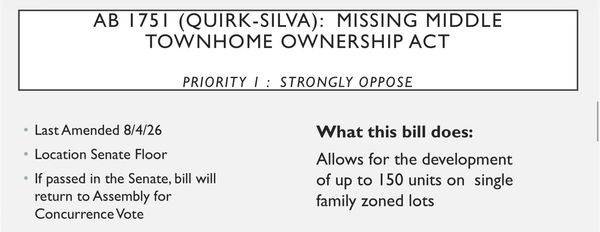
Bills are in the opposite house, and if they survive a floor vote they go back to house of origin for concurrence vote before 8/31.
SEND LETTERS IN ASAP!
The Senate convenes today at 2:00 p.m. and tomorrow at 10:00 a.m.
So the ones to watch today are AB 2005, SB 954, SB 569 and SB 1116. AB 1751 is one procedural step behind because today’s Daily File still has it at Second Reading.
INSTRUCTIONS FOR PORTAL LETTERS AT BOTTOM OF PAGE. Please SIGN your letters.
VOTE NO on AB 2005, AB 1751, SB 1116
VOTE YES on AB 2576
Each of the bills is explained in the letter.
Email addresses filled out for each; customize and sign sample letters.
The Senate convenes today 8/24 at 2:00 p.m. and tomorrow at 10:00 a.m.
So the ones to watch today are AB 2005, SB 954, SB 569 and SB 1116. AB 1751 is one procedural step behind because today’s Daily File still has it at Second Reading.
For Floor and Concurrence letters:
CALL or EMAIL
Tell Senators you strongly oppose these bills:
1. AB 956 (Quirk-Silva)
2. AB 1751 (Quirk-Silva)
FIND CONTACT INFO HERE:
https://www.senate.ca.gov/senators
CALL or EMAIL
Tell Assembly Members to strongly oppose these bills: 3. SB 569 (Blakespear) 4. SB 958 (Weber-Pierson) 5. SB 1116 (Caballero) 6. SB 1361 (Arreguin)
CONTACT INFO HERE: https://www.assembly.ca.gov/assemblymembers

Huge burden on single family neighborhoods
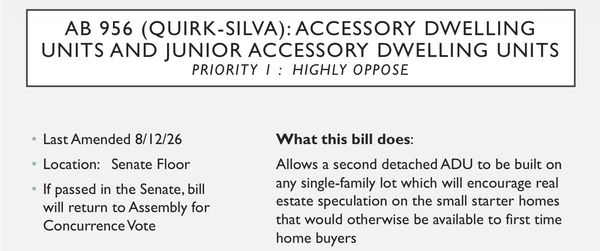
Increases speculation in areas already affordable as starter homes.

Cities can’t even discuss the effect transit plans might have on their exposure to SB 79 upzoning. More on 1361 below.
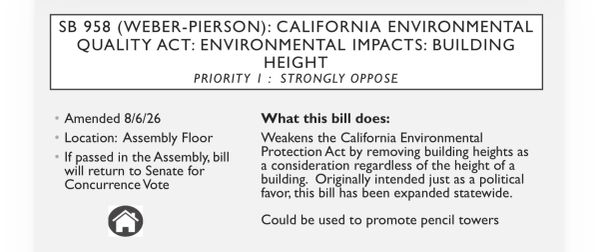
Why exempt building heights from impact studies?

Makes street level decisions a matter I’d statewide concern, and restricts removal of certain bike lanes after the fact — even if they are found to restrict evacuation access or are not working in practice.

Co-authored by Damon Connolly, this bill restores some of the CEQA protections — not even housing related -— stripped by Newsom’s last minute budget trailer bills — including ADVANCED MANUFACTURING.
• Restores environmental review and public disclosure for 75+ categories of heavy industry that SB 131 exempted — projects that can currently be approved with no environmental study, no required mitigation, and no notice to neighbors, schools, or first responders
• Bars the exemption for any advanced manufacturing project within 1,000 feet of a disadvantaged community
• Limits exemptions to “final tier manufacturing” — final assembly of market-ready products — while excluding chemical refining, extraction, and heavy recycling
• Widens the CEQA definition of “natural and protected lands” to include habitat for candidate, sensitive, and special-status species , plus clarifies exemptions for residential daycare facilities
Status: Passed the Senate 23–9 and cleared Assembly Natural Resources and Labor & Employment; as of 8/4 awaiting a hearing in Assembly Appropriations.
Backing: Supported by a coalition of 125+ labor, conservation, environmental justice, and public health groups. Opposition argues added regulatory layers will push advanced manufacturing out of state.
NOTES FOR LETTERS OF OPPOSITION TO SB 1361
SB 1361 has been modified as follows, to prohibit cities from conditioning an SB 79 project based on its impacts. Need to urgently object to this:
“
(2) A local government with an existing or planned transit-oriented development stop shall not do any of the following:
(A) Request the transit agency to reduce service provided to the transit-oriented development stop, remove a transit-oriented development stop, or remove a dedicated transit lane so that the requirements of this chapter do not apply.
(B) Condition or withhold an approval or review of a transit project that includes a transit-oriented development stop on the basis of the impacts of additional height or density available to a transit-oriented housing development project as required by this chapter.
(C) Withhold or withdraw support of an application forfederal funding of a transit project that includes a transit-oriented development stop on the basis of additional height or density available to a transit-oriented housing development project as required by this chapter.”

Illustration by Darren Tu/KQED)
CONTACT YOUR ASSEMBLYMEMBER
OPPOSE SB 1361 (Durazo) — Assembly Floor Vote
And ask them to vote NO when SB 1361 comes before the Assembly,

To: President pro Tempore Limón and California State Senators
Re: AB-956 Accessory dwelling units and junior accessory dwelling units. OPPOSE
Senators:
[organization or individual] strongly opposes AB-956. Homeowners already have the option of adding two accessory dwelling units (ADUs) to their properties plus a junior accessory dwelling unit, so the major impact of this bill will be to turn what was originally intended to be a way for homeowners to add housing for family members or extra income into a program targeted to developers.
The bill will especially change the market for smaller homes (e.g., 1,200 sf homes on 5,000 sf lots). Today these small homes are available as starter homes to first time homebuyers, but if AB-956 is adopted, then these will become the primary target for developers, who can convert a garage or other space internal to the existing house and add two detached ADUs in the rear (four total rental units). Of particular concern is that many of the homes targeted by AB-956 are in California Tax Credit Allocation Committee (CTCAC) designated low opportunity communities, which raises concerns that AB-956 violates California’s commitment to affirmatively furthering fair housing (AFFH).
Finally, state laws are inconsistent. The side and rear setbacks for new detached ADUs are 4 feet, while the state has adopted a conflicting 5 foot setback requirement for Zone Zero (fire safety). Setbacks for ADUs and all other infill housing programs should be increased to 5 feet to match Zone Zero requirements, especially since fire hazard zones are likely to expand in coming years due to climate change.
Based on the above reasons, I urge you to oppose AB-956.
Respectfully,
[name of person and organization, if applicable]
To: Speaker Rivas and California State Assembly Members
Re: SB-1116 Planning and zoning: housing development projects: subdivisions. OPPOSE
Cities are still implementing SB-1123 – It’s premature to be making drastic changes.
SB-1116 proposes numerous changes to the current regulations that significantly change the allowed scale and eligibility of SHRA developments. While the current SHRA regulations are mostly consistent with existing zoning, SB-1116 disregards “missing middle” principles and pushes heights, setbacks, and floor area ratios beyond reasonable values. SB-1116 includes drastic reductions minimum lot sizes, from 600 to 480 square feet in multi-family zones, and from 1,200 to 960 square feet in single-family zones. The proposed reduced lot sizes are inconsistent with other state and local standards for small lot subdivisions, such as SB-9.
Changing the definition of “vacant” lot to reference Section 1941.1 of the Civil Code invites abuse. Section 1941.1, which calls out easily repaired defects such as broken windows, is fundamentally a tenant protection law intended to force landlords to provide safe and healthy homes for their tenants, not to allow developers to game state law by vandalizing their own properties.
SB-1116 explicitly promotes confusion, uncertainty, and overreach in its implementation by stating that “This section shall be interpreted liberally in favor of producing the maximum number of total housing units.” Based on experience with other state laws, this clause will give free rein to the Department of Housing and Community Development (HCD) to invent whatever it wants from the language of the law. This violates California’s separation of powers. When a law is vague, then it is the sole responsibility of the Legislature to fix it, not a free pass to California’s executive branch to make up whatever it wants the law to be.
Again, it is premature to make significant changes to the scope of the Starter Home Revitalization Act before the existing regulations have had a chance to be implemented and prove their effectiveness, which will take a few years as developers acquire properties and execute projects.
At this time, the Legislature should focus its efforts on creating reporting requirements to assess the effectiveness of the SHRA and other state-mandated housing regulations, so that it can make data-driven decisions about whether to change the regulations in future Legislative sessions.
It is extremely difficult to roll back regulations once they’ve been adopted, and we ask the Legislature to show restraint and patience by rejecting SB-1116.
Respectfully,
[name of person and organization, if applicable]
Yes, if submitted by the deadline. Organization letters are listed in the public record. As YIMBY and other organizations are writing or sponsoring legislation, they are aware of it in advance, and often submit many letters in support of a bill. We don't have the luxury of advance notice, but if we don’t submit letters the public record looks like no one opposed the legislation.
Yes, if you want o send letters to committees online. After you set up an account — you only sign up once (it’s easy) your comments can go to both Senate and Assembly committees , just by clicking through a few forms. Write your letters before you open the portal — individuals can copy the text into a box. Organizations will upload a file.
VIDEO INSTRUCTIONS AT THIS LINK. Written instructions below.
https://nourishca.org/GeneralNutrition/Legislation/How%20To_%20CA%20Leg%20Portal-2020.pdf
At the top, include your name, address, and date. Address it to the correct committee, formally with the Hon. (Committee Chair’s Name), followed by name of committee.
SUBJECT AND SUBJECT LINE
In the subject line, add the bill number with OPPOSE or SUPPORT
YOUR LETTER can be as simple as a note that says you oppose or support, or write more. You can write that you support the Citizen Marin or another organization/ individual’s letter

The PCL has been involved with California environmental legislation for over 60 years. Visit their site for current bill tracking — latest issue is focused on water related bills GREAT CEQA COVERAGE
Right to Know — SB 954 (sign the petition)
Fixing What They Broke — SB 954 (PCL)
CEQA by the Numbers: Myths and Facts
PCL: the CEQA Works Coalition
On Wildfire and CEQA:
https://calmatters.org/commentary/2026/08/wildfire-mitigation-environmental-protection-california/
Our laws created wildfire safety standards for a reason: public safety. They are latest wildfire science applied to real scenarios. Our fires are becoming more frequent and intense, and we have seen the devastation that people fleeing will face. Unfortunately, not all areas can support heavy population evacuation; in many cases egress is constrained for even current residents.
Many areas can safely support the housing we need without putting residents in harm’s way; builders should not be able to opt out of the regulations created to keep this balance. We need to protect communities by strengthening, not weakening evacuation and fire safety standards.
This bill would allow developers to use outdated standards without following the latest fire safety standards be followed.
Care deeply about protecting our natural landscape, reducing wildfire exposure, and responsible planning? This legislation is narrowly targeted at helping one developer bypass the latest wildfire safety standards on a technicality. Our climate disasters are worsening and we need to be oreosred to live with them.
The laws from 12 years ago have not protected us which is why we've passed numerous laws in the past 10 years to protect communities.
We use cookies to analyze website traffic and optimize your website experience. By accepting our use of cookies, your data will be aggregated with all other user data.